NeurIPS 2026

Nature3D-AD

Geometry-Aware Feature Learning for Natural-Growth 3D Anomaly Detection

Jian Ning1 Qin Zou1,2,* Linchun Wu1 Kunmo Li3 Chi Chen2,4 Zhen Dong4 Bisheng Yang4 Qingquan Li4,5

1School of Computer Science, Wuhan University 2School of Robotics, Wuhan University 3School of Computer Science and Technology, Dalian University of Technology 4State Key Laboratory LIESMARS, Wuhan University 5Guangdong Key Laboratory of Urban Informatics, Shenzhen University

*Corresponding author

Real 3D scans from the NaturalGrowth benchmark
Real 3D scans of agricultural products from NaturalGrowth, covering 31 categories with large intra-class shape variation.
31Agricultural categories
1,477Real 3D scans
155KPoints per scan (avg.)
3Benchmarks, best avg. O-AUROC

Overview

When "normal" is not a template

Existing point cloud anomaly detection benchmarks are designed for industrial parts, where normal samples share standard geometric shapes. Agricultural products grow naturally: their shape, size and texture vary widely, so "normal" is far less well-defined, and industrial benchmarks and methods do not transfer well.

We build NaturalGrowth, the first point cloud anomaly detection benchmark for agricultural products, and propose GESA, which injects geometric priors at two levels. ASPE fuses local curvature and density into the position embedding to enhance the perception of anomalous regions, and GAA adds geometric biases and a spectral branch to attention to strengthen local structure modeling. Experiments on NaturalGrowth, Real3D-AD and Anomaly-ShapeNet show competitive performance with a single unified model per dataset.

Benchmark

NaturalGrowth

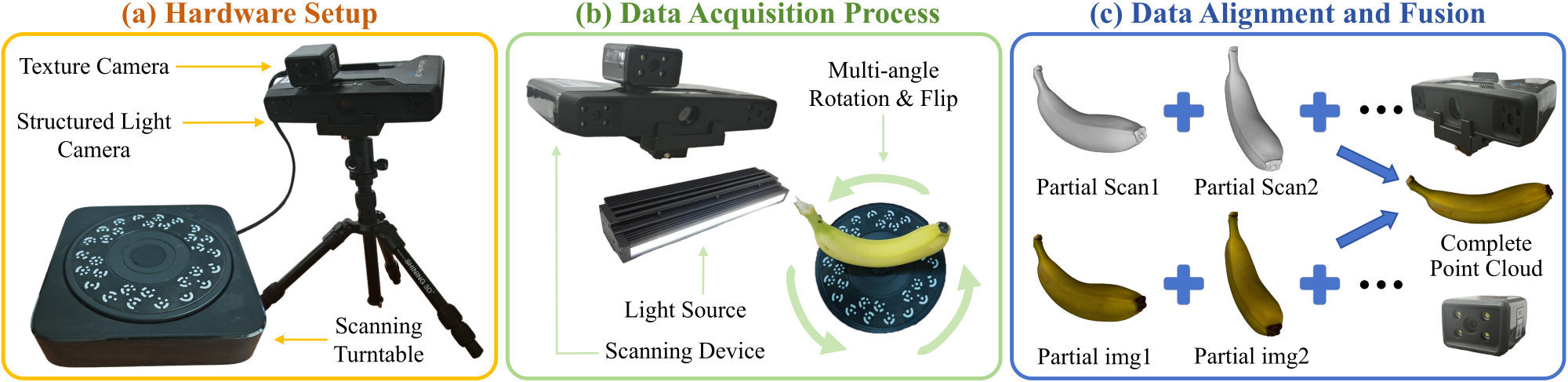
31 categories of common agricultural products, scanned with an industrial structured-light scanner on a turntable for full 360° coverage. Defects are real: natural ones such as wormholes and rot, and physical damage from picking and transport. Every defective sample has point-level ground truth.

Data acquisition setup of NaturalGrowth
Data acquisition pipeline.

Method

GESA: geometry priors in embedding and attention

ASPE

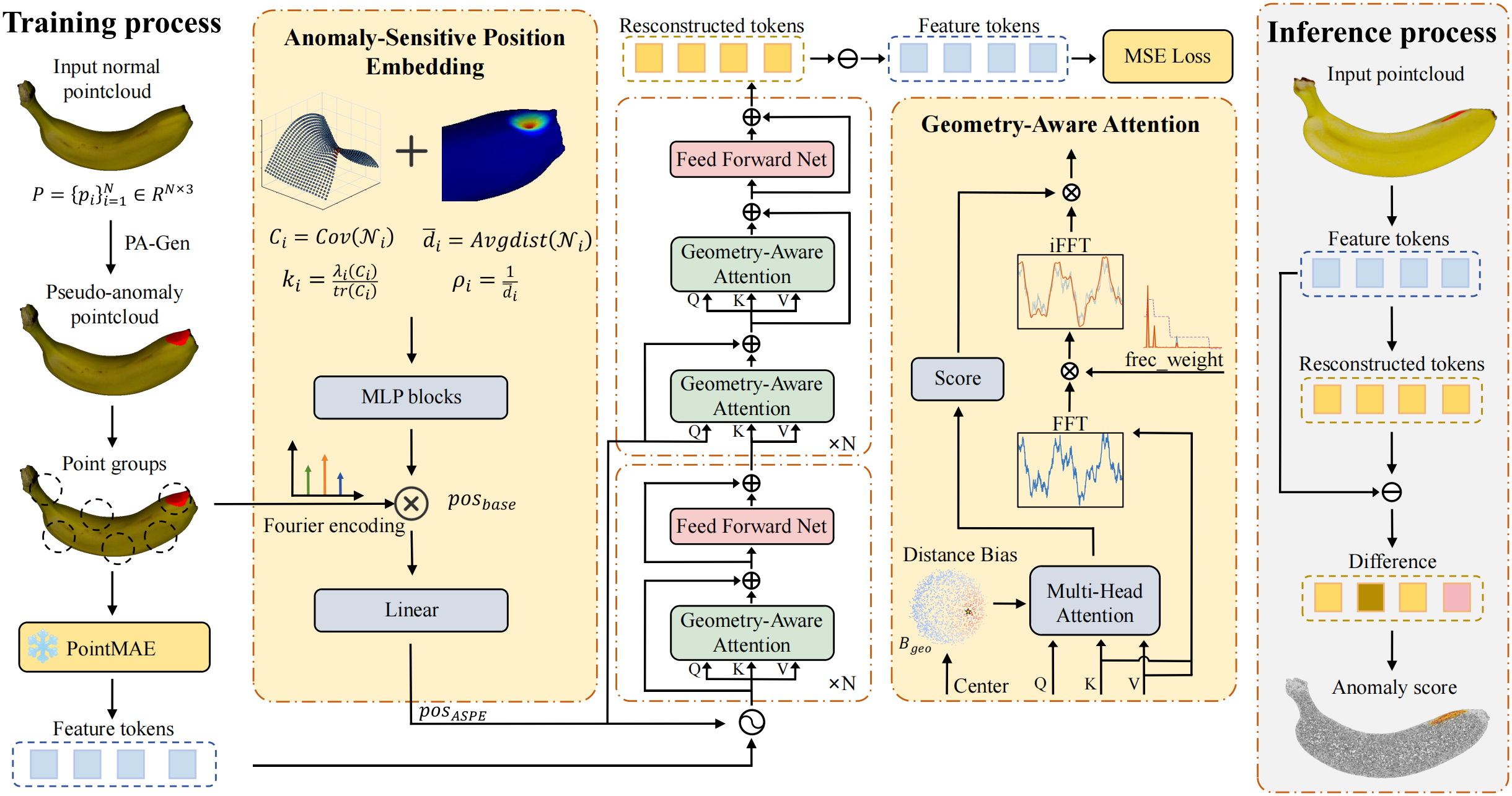
Anomaly-Sensitive Position Embedding. Local curvature and density modulate a Fourier position embedding, so potentially anomalous regions get a stronger positional signal.

GAA

Geometry-Aware Attention. Distance and normal-similarity biases are added to the attention scores, making attention aware of 3D structure.

Spectral branch

An FFT-domain branch is fused with spatial attention. Global frequency patterns stay robust to the irregular shapes of natural products.

Overview of the GESA framework
Overview of GESA. A frozen Point-MAE backbone extracts group features; stacked GAA encoder/decoder layers with ASPE reconstruct normal features, and the reconstruction error gives point- and object-level anomaly scores. Click to enlarge.

Results

One model per dataset, best average O-AUROC

NaturalGrowth 0.853 6.1% over 2nd best
Real3D-AD 0.887 8.3% over 2nd best
Anomaly-ShapeNet 0.933 7.2% over 2nd best

Ablation on NaturalGrowth (O-AUROC)

Baseline Transformer
0.792
+ ASPE
0.813
+ Geometric bias
0.804
+ Spectral branch
0.824
Full GESA
0.853

Bars start at 0. Each module improves over the baseline; the three are complementary.

Qualitative results

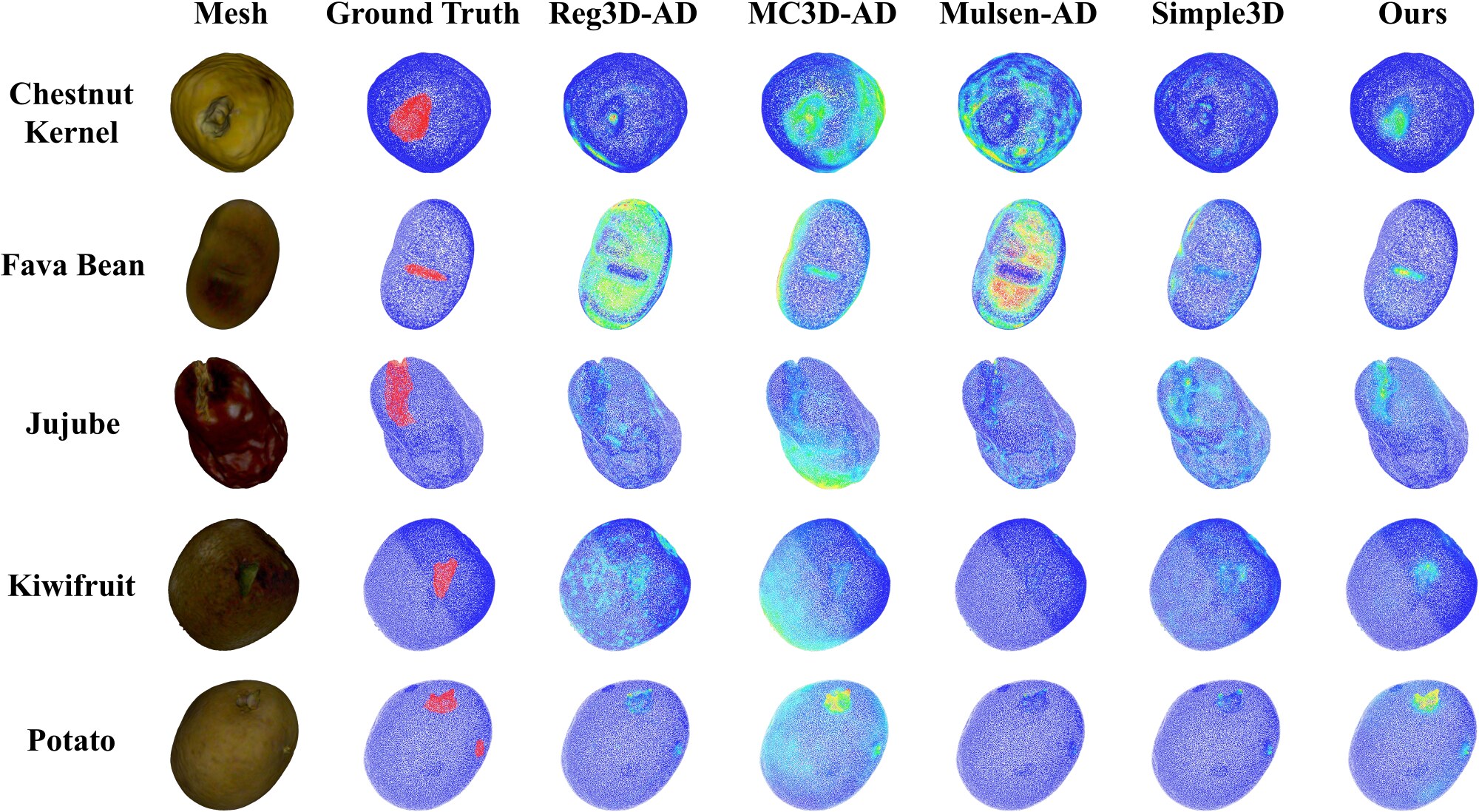
Qualitative anomaly localization results
Point-level anomaly localization on representative samples, compared with the ground truth. Click to enlarge.

Citation

BibTeX

@inproceedings{ning2026nature3dad,
  title     = {Nature3D-{AD}: Geometry-Aware Feature Learning for Natural-Growth 3D Anomaly Detection},
  author    = {Jian Ning and Qin Zou and Linchun Wu and Kunmo Li and Chi Chen and Zhen Dong and Bisheng Yang and Qingquan Li},
  booktitle = {The Fortieth Annual Conference on Neural Information Processing Systems},
  year      = {2026},
  url       = {https://openreview.net/forum?id=WWUQ1mmWsN}
}